Table of Contents
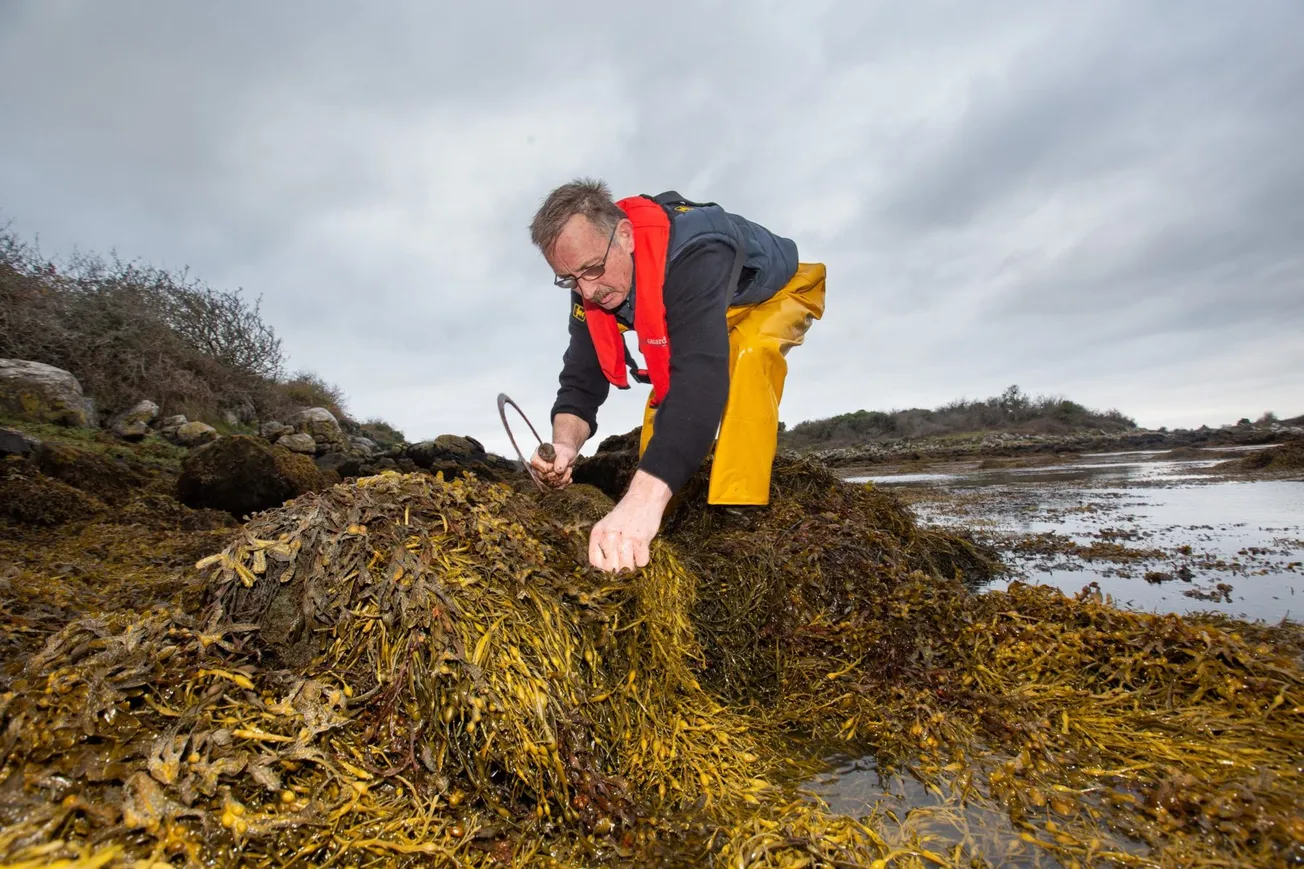
The knife has to be right. If you cut too close to the rock, you take the holdfast — the root, more or less, though a botanist would correct you — and the plant does not grow back. Ascophyllum nodosum, knotted wrack, can live for fifty years. It grows slowly, stubbornly, clinging to the intertidal stone in a place where almost nothing else persists. A good harvester leaves twenty-five centimetres attached. He comes back in three to five years. The shore provides, and provides again, on the condition that you do not take everything.
In Connemara they gather the cut wrack into bundles of two or three tonnes, bound with twenty-metre nets and rope. The bundles are called climíní, a word that has no English equivalent and doesn't need one, and they are left on the shore to be collected by mechanical grab and trucked to the factory at Cill Chiaráin — "Ciarán's church," though the church is long gone and the factory is what remains. For seventy-eight years, Arramara Teoranta has been drying and milling seaweed there. It was once a semi-State company, funded by Údarás na Gaeltachta to keep employment in a region where employment is not a given. In 2014, it was sold to a Canadian multinational called Acadian Seaplants. The price was never disclosed. A ten-year confidentiality clause saw to that.
This might not matter much except for what happened next.
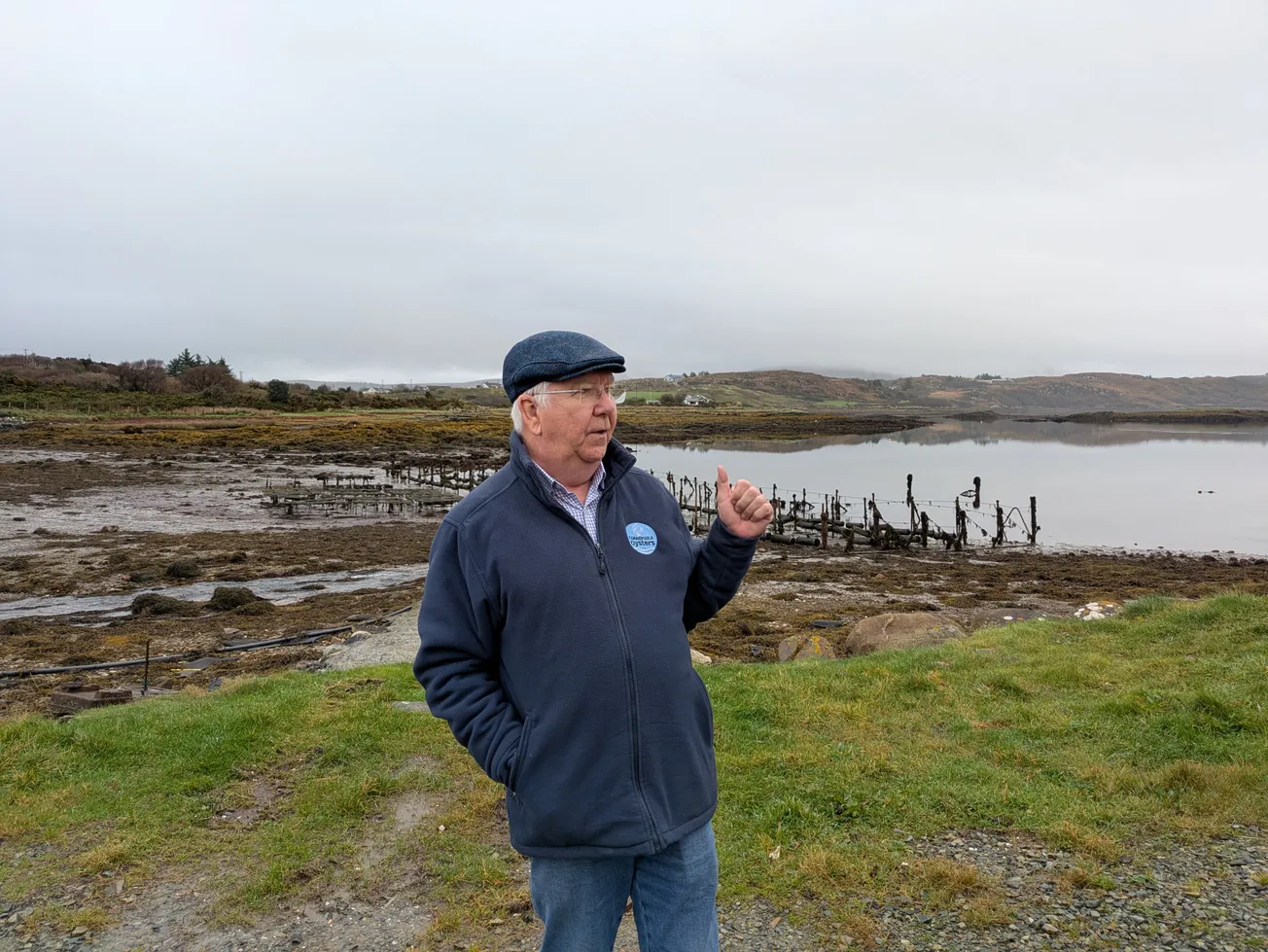
On the second of February this year, roughly three hundred seaweed harvesters gathered in Ros Muc, a village in the Connemara Gaeltacht whose name, if you are American, you will not pronounce correctly on the first attempt. They were there because Arramara — now Canadian-owned, still Connemara-based — had filed five applications with MARA, Ireland's new Maritime Area Regulatory Authority, for licences to harvest knotted wrack and bladder wrack across five bays: Cashla, Kilkieran, Greatman's, Bertrabuoy, and Mace Head. The bays stretch along the coastline closest to the Cill Chiaráin factory, which is to say they stretch along the same foreshore where local families have been harvesting seaweed by hand for as long as anyone can remember, and in some cases longer. Maidhc Ó Curraoin's family has cut seaweed for over a hundred years. He does not consider this a hobby.
The meeting was heated. Éamonn Mylotte from Carna put it plainly, to applause: it is a property title we have on our land and the foreshore, not a licence with permission to cut seaweed. And if all our rights go to Arramara and they sell the factory or whatever they have, then we end up with nothing.
He did not say it politely. He said it was time to bloody cop on.
The legal architecture beneath all of this is, as one might expect from Irish property law, magnificently complicated. Since the Foreshore Act of 1933 — itself now replaced by the Maritime Area Planning Act of 2021 — the State has generally owned the foreshore, from the high-water mark out to twelve miles. But nested within that ownership are older rights, some of them centuries old, attached to specific parcels of land. These are called appurtenant rights, and they work roughly the way turbary rights work for turf: if your folio — the property registration document — specifies a right to harvest seaweed from a particular stretch of shore, that right is yours regardless of what the State does with the foreshore around it. It is, in a sense, a property right that predates the property regime.
In County Galway alone there are two thousand five hundred folios with seaweed appurtenant rights. In Mayo, about fifteen hundred more. Subdivision of land over the decades has multiplied these numbers further. When Arramara first applied for harvesting licences back in 2014 — the year Acadian bought the company — it sought permission to harvest on an industrial scale across a vast stretch of coastline from Sruwaddacon Bay in north Mayo to Black Head in north Clare. The application was so tangled in competing rights that the junior minister of the day suspended the process and referred the whole mess to the attorney general. Out of that referral came a landmark 2018 clarification: the State cannot licence seaweed harvesting in an area where existing harvesting rights already apply. The traditional rights were to be respected.
Arramara, to its credit or its patience, went back and spent a decade working with Tailte Éireann, the State's property registration service, to map which stretches of shore were encumbered by appurtenant rights and which were not. It turned out to be about half. The five applications now before MARA cover only the unencumbered half.
The harvesters are not reassured.
What unsettles them is less the letter of the current application than the direction of the current. A Canadian multinational does not spend a decade mapping property rights for the pleasure of the exercise. The global seaweed industry is projected to reach twenty-two billion euro by 2028. Knotted wrack — the same species a Connemara harvester cuts with a sickle at low tide, leaving the holdfast intact — is in demand for animal feed, agricultural biostimulants, cosmetics, and pharmaceutical applications. The stuff that was once a famine food, spread over stony fields to coax potatoes from soil that had no business growing them, is now, as Ó Curraoin put it to RTÉ, the new gold or the new oil.
The harvesters earn a hundred euro per tonne.
That figure is worth sitting with. The global industry measures itself in billions. The people who do the cutting — by hand, at low tide, with a knife — bring home roughly ten thousand euro a year from it. The total annual value of Ireland's wild seaweed harvest is approximately two point seven million euro. Arramara alone generates, by its own account, four million euro for the local economy and employs twenty-odd people at the factory. The harvesters provide the raw material. They are, in the language Arramara itself uses, "the backbone" of the operation. Backbones, as a rule, are not consulted about the organism's plans.
There is a passage in Séamus Mac an Iomaire's Cladaigh Chonamara — The Shores of Connemara, published in 1938 — that the ecologist Cillian Roden described as dispelling the myth that the people of Ireland were a race of thalassophobes, incapable of observing their natural surroundings. Mac an Iomaire wrote about the shore the way a man writes about something he knows with his hands. Every species had a name, a season, a use. The knowledge was granular and unsentimental and it had been accumulating for centuries. You can find a faint analogy in the Gullah Geechee communities of the Carolina and Georgia coast, where cast-net shrimpers and oystermen carry a similar kind of knowledge about tidal creeks and pluff mud — knowledge that is practical, inherited, and invisible to anyone who didn't grow up with it. It is the sort of knowledge that gets called "traditional" in policy documents, which is a way of honouring it without having to pay for it.
The new licensing regime under MARA requires everyone — including holders of appurtenant rights — to apply for a maritime usage licence by July 2028. The harvesters see this as a kind of forced formalisation of something that never needed formalising. Ó Curraoin does not object to getting a licence if that is what is required. But he does not think he should need one, because his family's rights are on the folio, and he worries about what happens when the licence system favours the entity with the lawyers and the ten-year mapping project over the man with the sickle and the knowledge of his own shore.
Joe Mortimer, who has been cutting seaweed along the shoreline of his farm on Clew Bay since he was ten, would like to speak to whoever is in charge. Give us all our individual licences for our pieces of the shoreline, he says, and do not leave us having to fight off the big companies. He has sold to Arramara since 1999. He finds them very straight. He was even taken to the Acadian plant in Canada and treated very well. He is still committed to the traditional rights.
This is not, in other words, a simple story of a rapacious corporation descending on a helpless community. Arramara has been in Cill Chiaráin since 1947. It has fed families. Its harvesters are, in many cases, the same people now protesting its licence applications. The company argues — and it is not an unreasonable argument — that without a secured supply of raw material, the factory cannot operate, and without the factory, the twenty jobs and the four million in local economic activity disappear. Jim Keogh, Arramara's Europe director, is a former Údarás na Gaeltachta executive who has spent forty years trying to bring industry to coastal communities. He is not, by any measure, indifferent to their welfare.
But the harvesters have watched this sequence before. A State asset becomes a semi-State company. The semi-State company is sold to a multinational. The multinational needs to secure supply. The supply used to flow voluntarily from people with traditional rights. Now it will flow through a licensing regime administered by a regulatory authority established two years ago. The people who have cut the wrack since before the State existed are being asked to apply for permission to continue.
Arramara is not the only company at the door. BioAtlantis, a Kerry-based processor, has filed its own application with MARA for harvesting rights around Clew Bay — Mortimer's territory. Meanwhile, in Donegal, the Seaweed Company has built Ireland's first dedicated seaweed processing facility at Mulroy Bay with EU funding, farming kelp on longlines in a sheltered sea loch. Lorraine Gallagher, whose father is a custodian of the bay, runs the operation. Less than three hours from harvest to dried and bagged. This is a different model — cultivation rather than wild harvest — and it exists alongside the traditional one without, so far, displacing it. Whether that coexistence holds as the industry scales is a question nobody is answering with much confidence.
The global seaweed market wants volume. Ireland harvests between twenty-five and forty thousand tonnes of wild seaweed a year, nearly all of it by hand. Research from NUI Galway has found that manual wild harvesting can provide, at maximum, about eight per cent of a future production target of nine hundred thousand tonnes. The rest would have to come from mechanical harvesting or cultivation. The researchers at NUI Galway also noted, with the careful phrasing of scientists who know what they are saying, that the age profile of the average harvester and the difficulty in recruiting the younger generation to harvest seaweed poses a threat to this traditional practice.
Joe Mortimer sees it differently. He says there has been a big rise in young people cutting seaweed since Covid. The shore, it seems, has not yet lost its pull.
The word feamainn is Irish for seaweed. It is one of those words that sounds like what it describes — soft and wet and clinging. In the Foreshore Act of 1933, seaweed is classified as "beach material," the same category as sand, gravel, and stones. That classification made a kind of sense in an era when the primary commercial use was as fertiliser and the industry was modest. It makes considerably less sense now that the material is feeding a global pharmaceutical and biostimulant market worth billions and a Canadian multinational has spent ten years mapping the property rights that stand between it and the shore.
Séamus Mac an Iomaire would have had a view on all of this, though it is hard to say what precisely. His generation understood the shore as a commons, a shared resource governed by custom and proximity and the simple fact of showing up when the tide was out. The new regime governs it by folio, licence, application, and regulatory authority. Both systems claim to protect the resource. The question is which one protects the people who depend on it.
In Cill Chiaráin, the factory dries and mills the wrack. Along the bays of Connemara, the harvesters cut it with a sickle, leaving the holdfast intact. The plant grows back in three to five years. It has been growing back for as long as anyone can remember. The holdfast is the part that matters. It is the part you do not cut.