Table of Contents
I once read that it was a practice among some people to refer to their deceased loved ones in the present tense in order to keep their memory alive, and I adopted the habit around that same time.
I say, for example, that Mike makes Brunswick stew. Mike hasn't made Brunswick for over a decade because that is how long he's been dead, but he introduced it to our family, and his sons now make it every Christmas, the same way Mike makes it.
So, Nathalie Dupree and I share a favorite color, blue. Dupree's is sky blue, but mine is midnight blue. Blue is one of a handful of similarities between us, enough to register in my conscience.
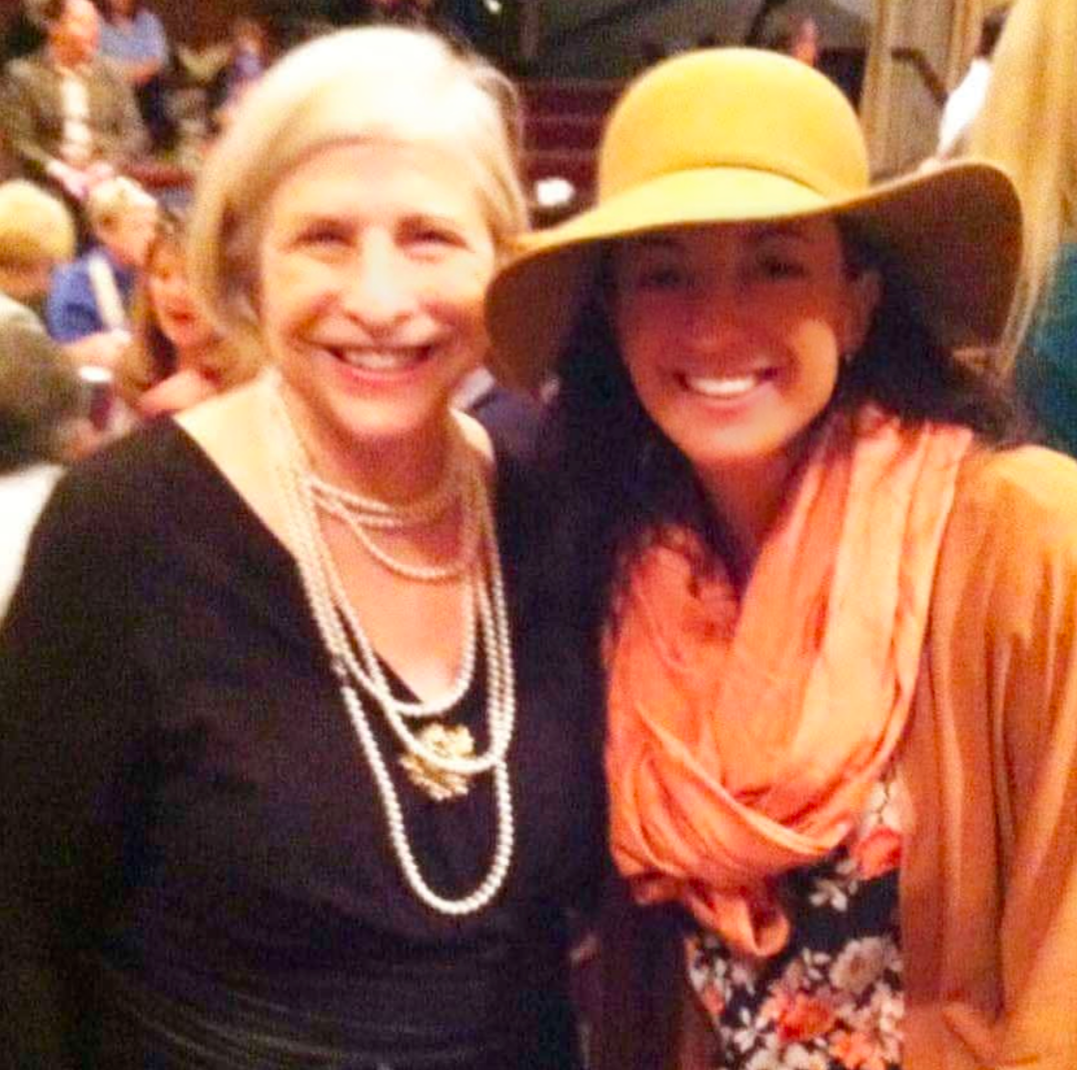
Dupree approved of my desire to write her biography, and knew when I went to USC shortly after she donated her papers, around the same time she moved to North Carolina. She knew I was unpacking something in my own mind in the following years, 2017-2025, and kept in touch with me for about half of the seven years I spent finding my way back here. She died a year ago today, around seven years into that journey, something I knew would inevitably happen before I started this work. I don't know why, exactly, except I do know that I thought of reaching out many times after she moved to North Carolina, thinking whether there was anything I needed to ask her while I still had time, but there just wasn't. Her legacy spoke for itself.
Dupree embraced new technology as just more tools in her kit, a suite that evolved with the times, from the public television of my childhood and cooking at Rich's in my native Atlanta to books and briefly, Instagram. She was born in New Jersey, but raised in Virginia and Texas. She came to Atlanta, where her in-laws lived, in the decade before I was born. In the late 1990s, we both moved to Charleston, South Carolina. I was still a teenager, starting at the College of Charleston. She had already cooked operated a kitchen in Majorca, studied at Le Cordon Bleu, sold nearly a million cookbooks, and the hosted hundreds of cooking shows.
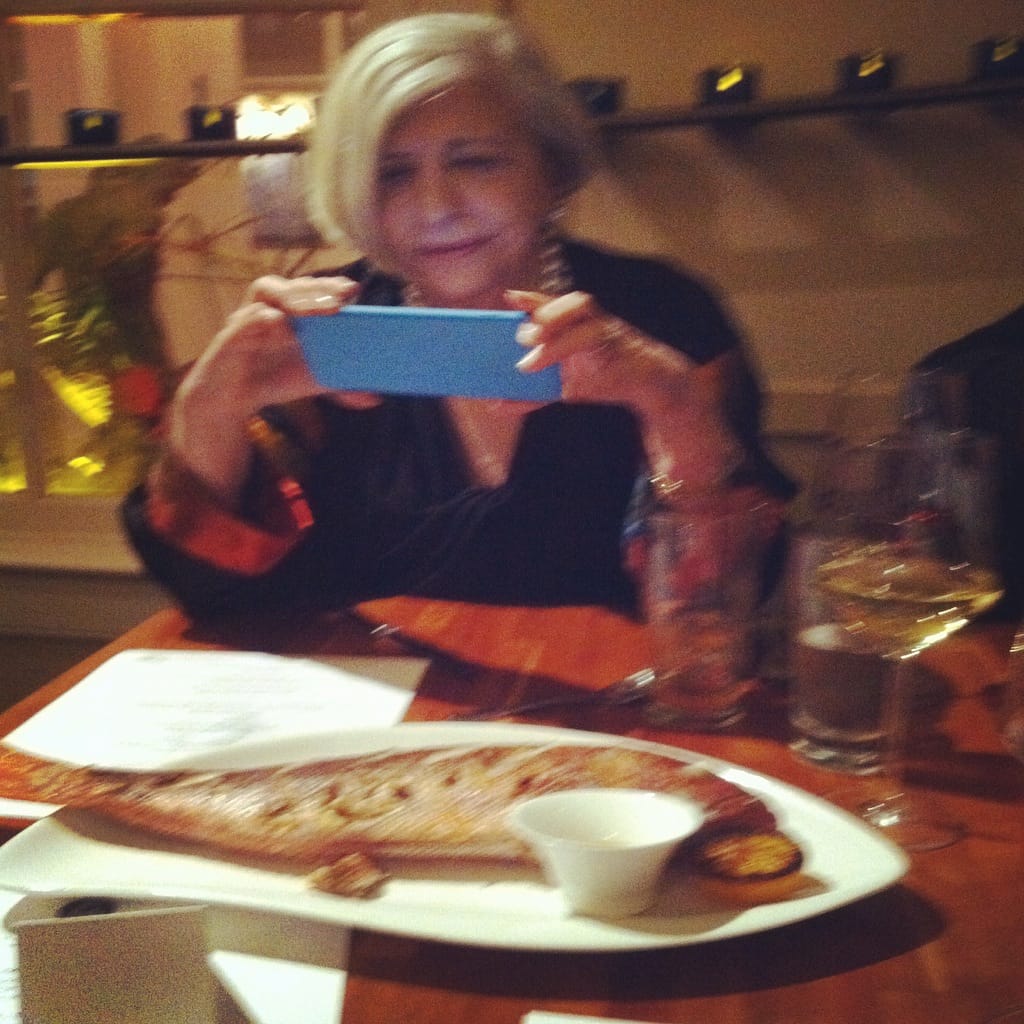
Her emails to me often requested ignoring grammatical mistakes from the iPad with a mind of its own. She was approving or inviting of my interest in both the biography and working my way through Mastering the Art of Southern Cooking, but I was conscious of living my own life as a priority, first leaving Charleston for South Africa, then finding my way onto professional yacht crews as a cook. Dupree encouraged me along the way. When I proposed cooking through the book as a fundraiser to attend Ballymaloe Cookery School's prestigious 12-week program in West Co. Cork, Ireland, which I'd learned about from the Scotswoman who first employed me on boats, Nathalie laughed it off, but I took it as permission enough.
I'd just re-watched Julie & Julia, making all the obvious connections. Dupree had met Child at Le Cordon Bleu, and Child encouraged her to teach and write Mastering the Art of Southern Cooking. The difference, I told Nathalie, was that Julie Powell hadn't known Child when she started the the Julie/Julia Project Blog to cook her way through Mastering the Art of French Cooking in a year. As I sat on the idea, I knew I did not want to simply repeat Julie Powell's act, although I am not one of her critics in calling the project a stunt (Child is said to have felt so). I empathize with Powell's impetus at the time; I imagine many others do, too, and feel it was a good contribution to the world and a thoughtful tribute to Child, only adding to her legacy for a new audience. When Powell died in 2022, she left a love letter to Child, and to home cooks with day jobs struggling to find the confidence to start. Powell created the space for Meryl Streep and Stanley Tucci to depict Julia and Paul Child, which alone was a gift to humanity.
"Ha! It's ambitious for sure! A couple of people have mentioned it, but not brought it up again."
— Nathalie Dupree, on the proposal of cooking my way through Mastering The Art of Southern Cooking ... in six months ...
Still, I knew my project had to be different. I was already a quasi-professional cook and a food writer privately denouncing ego, and overthinking what turns out to be my fairly basic voice. Knowing something needs to be unique and knowing how are two different things. I had to go on the journey. I had not to lose my voice, but to experience what it felt like to have it taken away more than once, to realize that simple and basic are not the same thing.
In the course of the seven years, I met cousins who my cousins and I didn't know we had, in Italy, who had been looking for us. The youngest of those four brothers, Piergiorgio is devilishly handsome. He did not believe me that ice cream was real. He insisted that a man making gelato must have simply had an accident in the kitchen. But he did help me discover and fall in love with fior di latte ("flower of milk") as a flavor I'd known without having a name for it. It wasn't vanilla. Vanilla is vanilla, says Piergiorgio in a strong Italian accent. Of course, this is simple: vanilla is vanilla, but have we forgotten the taste of milk enough to not give it its due as a flavor?
Much of my odyssey—yes, I compare it to the classic—has been in Ireland, where I drink grass-fed milk like shakes, and write about the natural precursor to serotonin in it, which isn't found in the corn-fed American counterpart. This is hardly virtue signaling; Manchán Magan died two weeks before I planned to see him perform in Galway this autumn, but not without just having published 99 Words for Rain and Ninety-Nine Words for Rain (and One for Sun) in celebration of the Irish language. That is to say the tryptophan in grass-fed dairy only starts to speak to the armor needed to combat winter in Ireland.
Fior di latte is not vanilla, and what is simple is not basic. The day will come when water sommeliers find their audience. Your senses already know that for which your language has, perhaps, lost the words. I've spent a lot of my adulthood around athletes and business people who speak quantitatively and measure in results. I get it, I really do. It's just that Nathalie Dupree was—no, Nathalie Dupree is—cool, and it so happens that her ultimate gift is in how she makes others feel, and you can't weigh that into a quantity to suit a recipe or a so-called "winner." You have to feel it in your hand, see it with your eyes, smell it, even, and know when it's enough. My answer to Julie & Julia, Powell's vehicle away from her New York City call center day job, Dupree & Me is of the kitchen, but not always in it. It is a vehicle back to the conversation, the stories and the people, that I've already declared matter to me. It's hard to explain, but so much of life is just finding an excuse to talk (or not) to people.
Seven years later, Ballymaloe has increased tuition a few thousand euros and my life has unfolded in ways I could not have seen coming. My story, it turns out, was the missing ingredient I needed to find to tell our shared one. In the summer of 2018, I remember going to the Borough Market in London to meet up with Nathalie, who was there with her Les Dames d'Escoffier friends. I was completely on my own, with the gift of a friend's house who was away. I made a day of it, navigating the Tube from East London. Meghan Markle was marrying Price Harry, and there were festivities in all the pubs. Between Nathalie's presence and the bunting and public parties, my self concocted agenda felt appropriate and eutopic. It is not lost on me that Markle married into the title "Duchess of Sussex" while Dupree earned the nicknamed "The Queen of Southern Cooking," and—while the wedding made good window dressing—to glimpse the latter was the object of my excursion. That is the last time I remember seeing her.
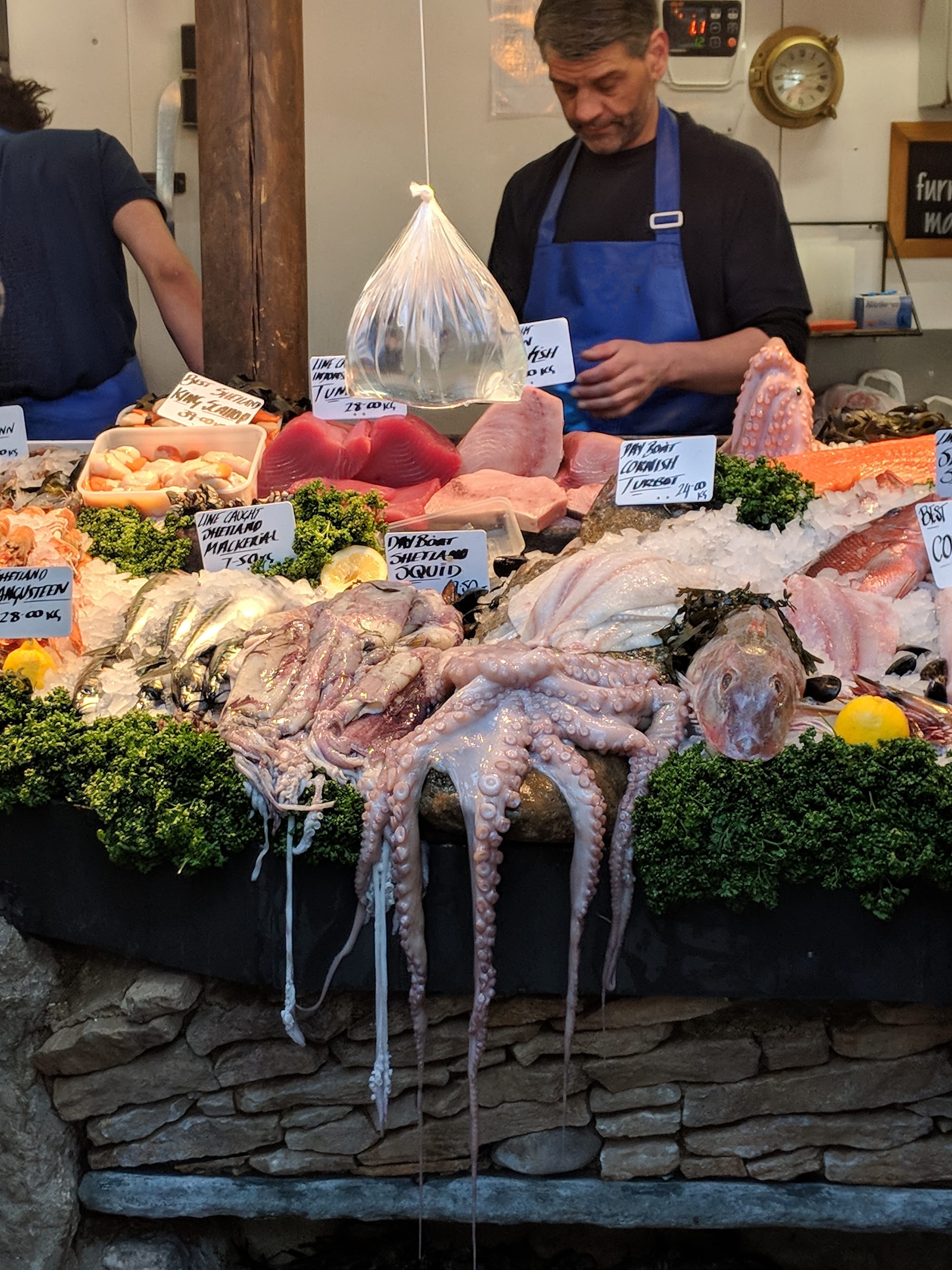
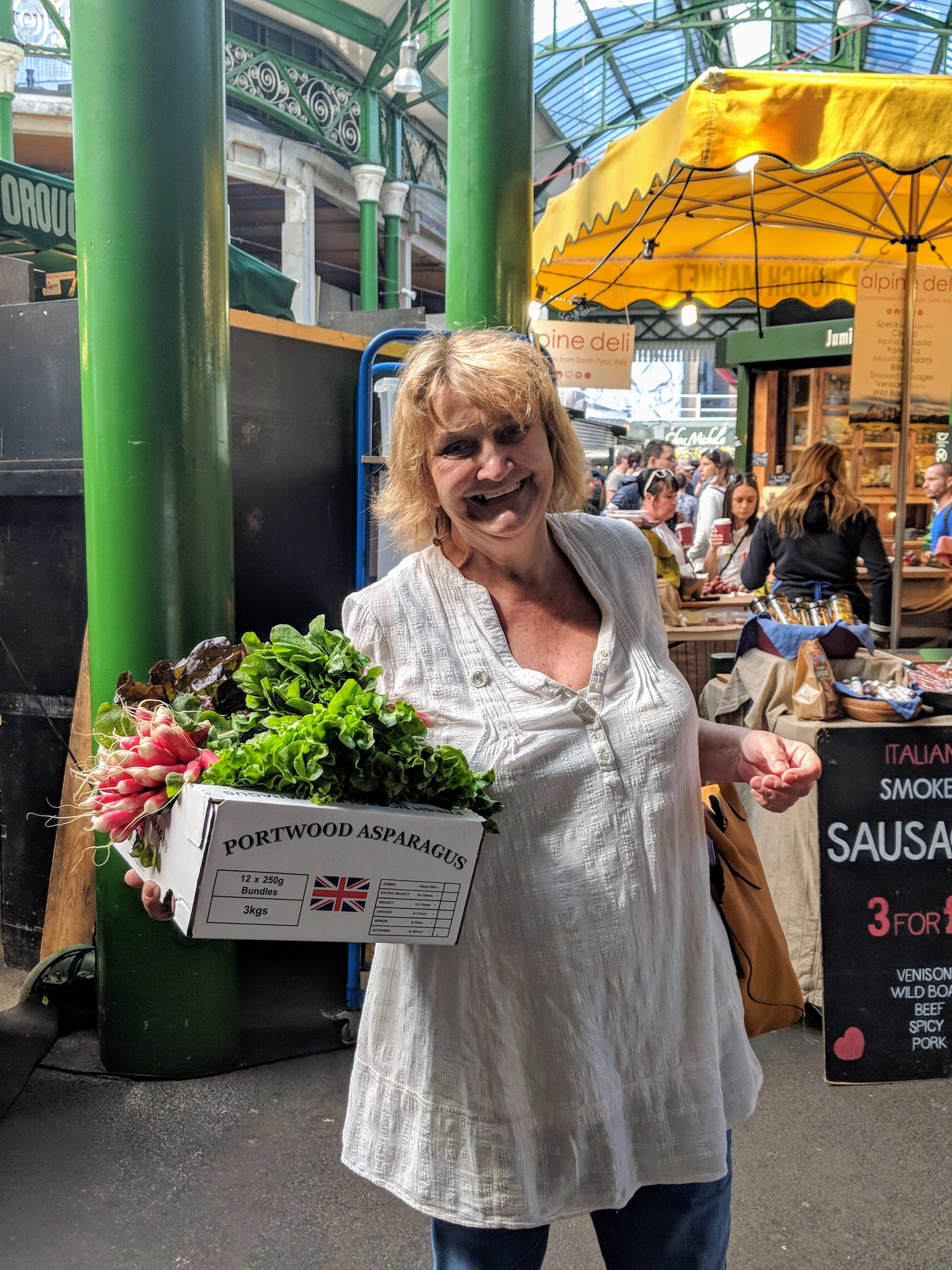
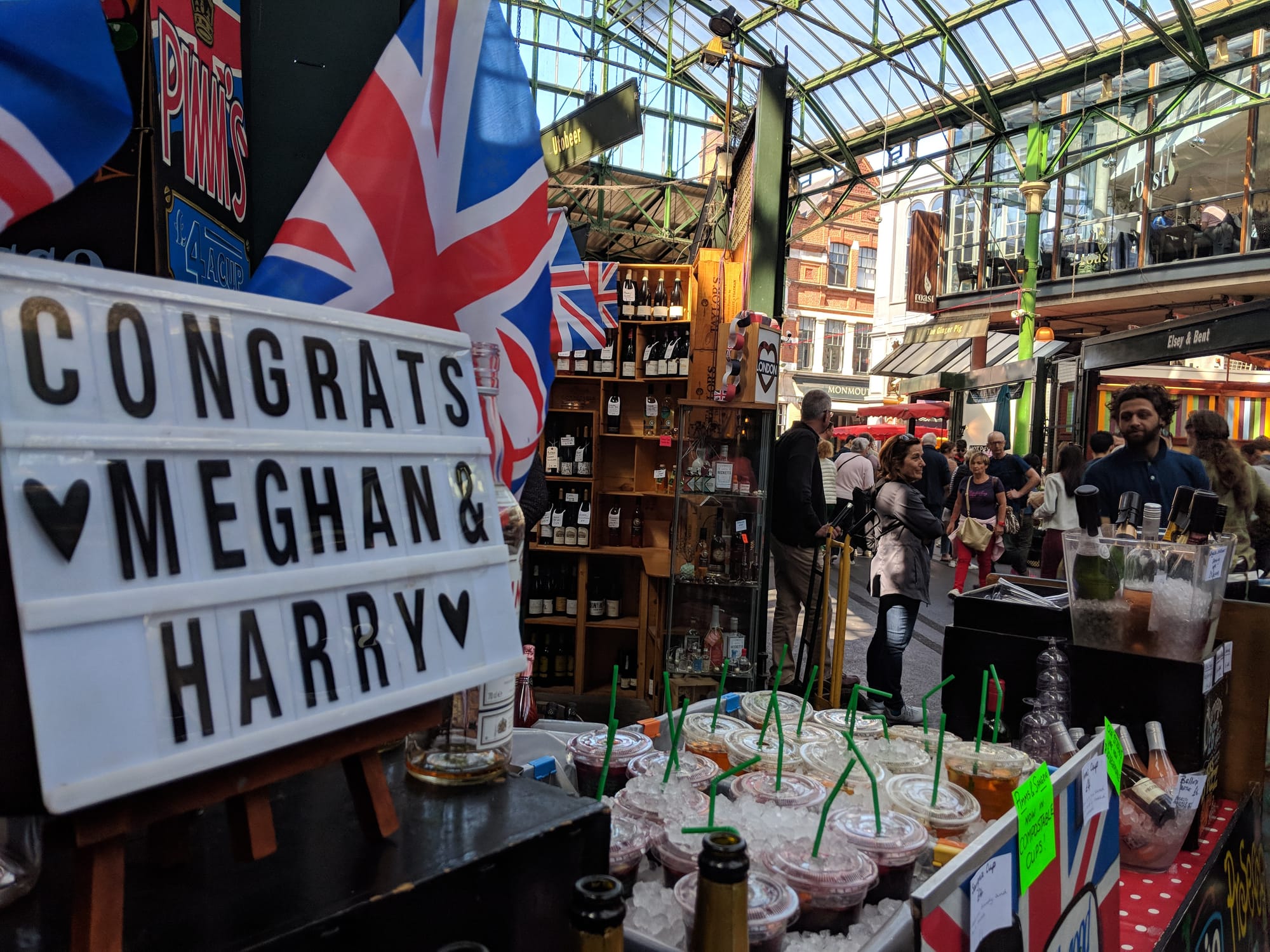
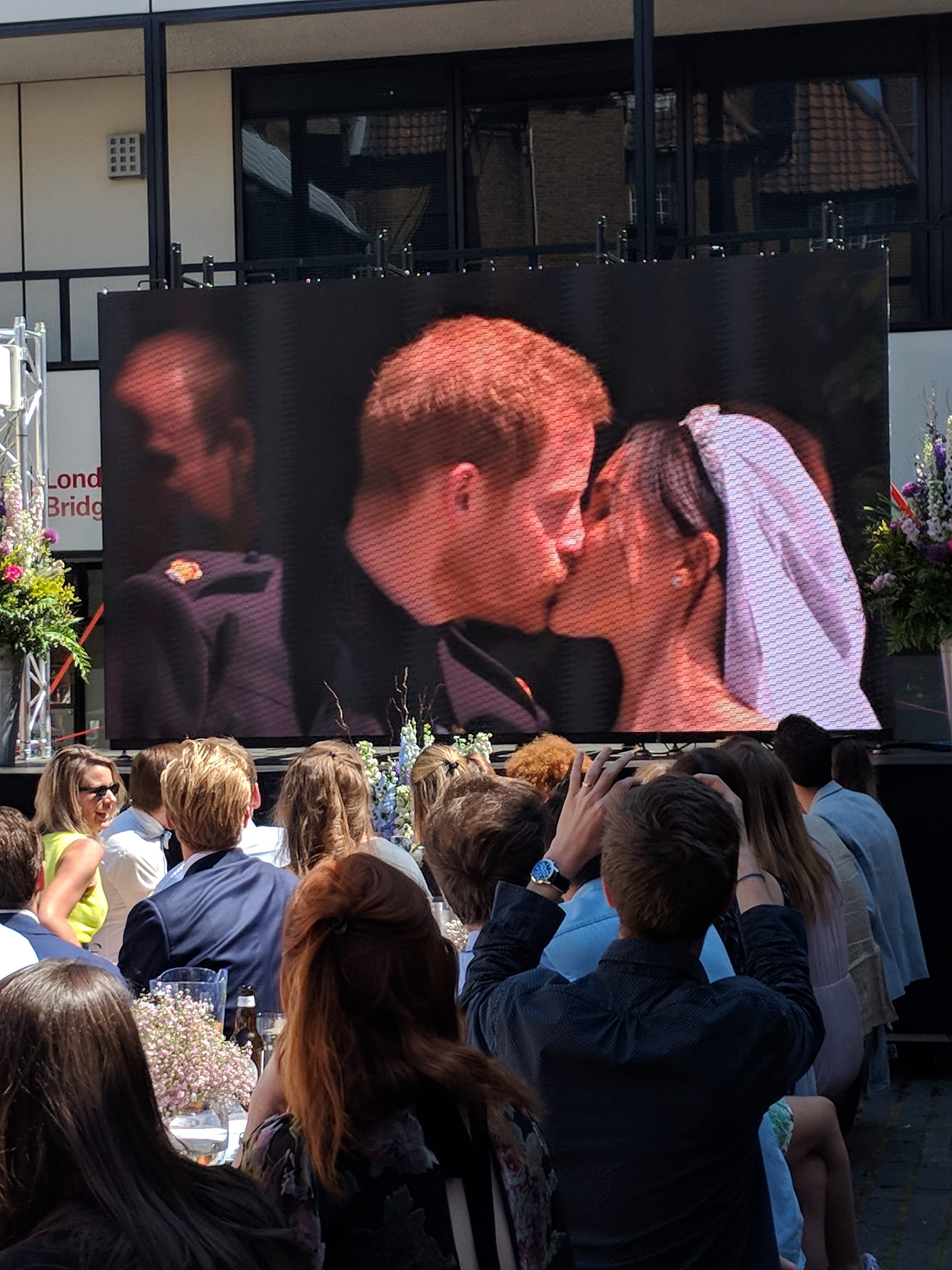
A London afternoon at Borough Market, 2018. I took a photo of Nathalie's friend instead of her, to feel less like a fan girl and more like a friend. Photos from Heather Richie.
Dupree has a group of women she mentored. They remain affectionately referred to as her chickens. I am more like her duck, but I like that. Even though ducks are most often thought of as odd, this is a recipe for belonging, no matter how big your skillet gets. There's a guy in Charleston we call Brother, I don't know his real name, but everyone called his father Duck because their surname is Mallard. Brother writes periodic Facebook posts to Duck, even though Duck died about ten years ago. We also call my nephew Brother because he's the youngest of Mike's five sons, and I don't know if it's Brother or Duck that I subconsciously associate with belonging, but my journey was the method for this recipe that helped me see the true art of Southern cooking, what Dupree truly mastered, and graciously shared with me. That's why I am sharing it with you.